

Why SILK Eye Surgery Protects Corneal Strength Better Than LASIK
- Plan My Lasik

- Jan 19
- 3 min read
In this current scenario, vision correction has modernized to a great extent. Millions of people are now subjecting themselves to LASIK to get rid of contact lenses and eyeglasses. However, with better technological advancements swooping in, patients are now looking for safer procedures offering newer techniques and long term results. That’s where SILK eye surgery in India gains tremendous popularity.
What Do You Mean by SILK Eye Surgery?
Smooth Incision Lenticular Keratomileusis is a flap-less vision correction method that’s minimally invasive- SILK is ideal for patients dealing with astigmatism and myopia (near-sightedness). While performing the procedure, a lenticule inside the cornea is created using a highly advanced femtosecond laser. A very small incision around 2-4 mm is done in the process.
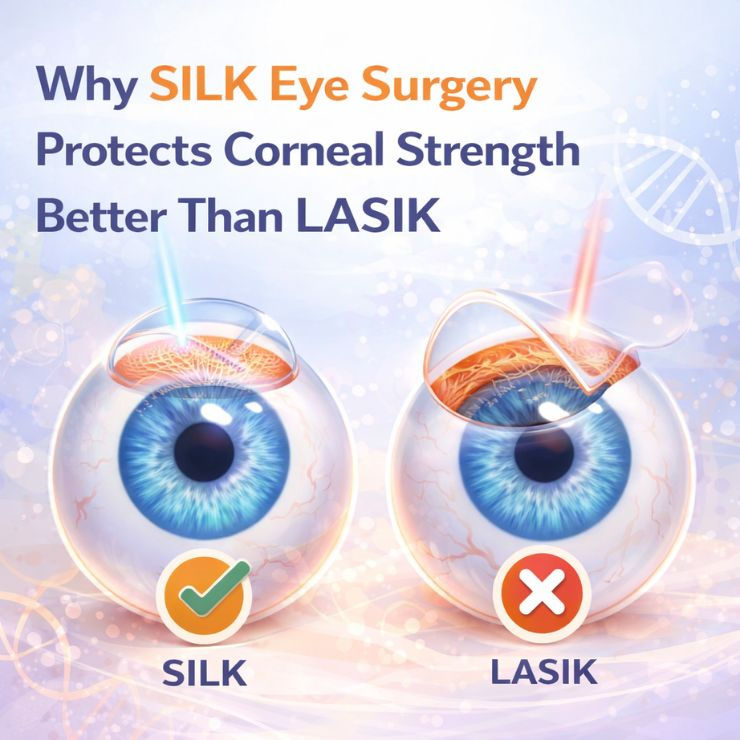
When compared to LASIK, there is no need for a large corneal flap in SILK. This, in result, preserves the cornea’s front layers and keeps its natural strength absolutely intact. Below are some of the clinical advantages of SILK; take a quick glance:
Thanks to the flap-less technique, it protects 30% of your eye’s corneal strength
SILK results in improved comfort and faster nerve healing post-surgery
Since smaller incisions are made in this process, it doesn’t damage nerve and reduce symptoms like dry eyes
If you have an active lifestyle and thin corneas, SILK eye surgery is one of the ideal treatment options to undergo
Injury related complications are rare
What Is LASIK and How Does it Work?
Liftable flaps allow surgeons to safely reshape corneal tissue using an excimer laser.
The following is a list of possible benefits of LASIK:
LASIK is a safe, effective treatment for myopia (nearsightedness), hyperopia (farsightedness), and astigmatism.
Visual recovery generally occurs rapidly, typically within 24 hours.
Below are some of the limitations of LASIK:
The corneal flap can weaken the cornea permanently by 30 to 40%
It can lead to post-surgery dry eyes
Flap-related issues can take place in this case
LASIK vs. SILK: Corneal Strength
Maintaining corneal stability after having surgery is critical to maintaining a long-term quality of life for your eyes. The front part of the cornea (the anterior cornea) is the strongest, and when using a large flap technique during LASIK Surgery, the strength of this part of the cornea is weakened, resulting in a higher risk of developing corneal ectasia (when the cornea begins to stretch and thin over time) compared to SILK eye surgery, which retains the structural integrity of most of the cornea and only makes use of a small incision.
Why SILK Is Better for Preserving Your Corneal Strength?
Risk of corneal ectasia is lowered up to 50 to 70%
Corneal stability after the surgery is improved/better
Anterior corneal layers remain untouched
The Science Behind SILK’s Safety Advantage
SILK preserves the deepest layers in the cornea, preventing big cuts or flaps. This will enable the cornea to manage the natural eye pressure better and daily stress for several years after surgery.
Patients experience fewer corneal nerves affected, which makes them experience:
Less dryness
Faster nerve regeneration
Better tear film stability
SILK also does not vaporize but removes tissue, and this helps to minimize the occurrence of heat related injuries and makes the surrounding corneal cells healthier. The use of high-end eye-checking technology will make the procedure accurate and safe.
Recovery After SILK Surgery
SILK provides comfortable recovery to most of the patients.
Recovery Highlights
Clearer vision within 24 hours
Get back to work/ routine within 1-2 days.
Little pain, irritation, or feeling of foreign body sensation.
Reduced risk of no flap leads to faster recovery of sports and other physical activities.
Post-Surgery Care
Take the prescribed eye drops.
Avoid rubbing the eyes.
Visit for follow-up visits regularly.
The SILK patients are always very satisfied with their recovery and long-term outcomes.
What to Choose: SILK vs. LASIK.
The appropriate procedure will be based on personal eye condition and lifestyle requirements.
SILK Is Ideal For:
Thin or weaker corneas
Myopia or astigmatism of a specific type.
Athletes or individuals who have physically demanding work.
Individuals interested in long-term corneal strength.
LASIK May Be Suitable For:
An expanded spectrum of refractive defects.
Patients who are after a well-established procedure.
The ones with heavier and healthier corneas.
Conclusion
Procedures related to vision correction are changing, and operations such as SILK are redefining what patients expect out of the eye surgery. Providing good visual results and maintaining corneal integrity and minimizing risk, SILK eye surgery in India is a safer and more future-proof potential alternative to classic LASIK.
With proper advice and technology, patients are able to have a clear vision today and preserve the health of their eyes in the future.


Comments